- Nimitz Tech
- Posts
- Nimitz Tech Hearing - 3-18-2026
Nimitz Tech Hearing - 3-18-2026
News Flash: Grid holds through Winter Storm Fern, but cracks in reliability and infrastructure remain.
⚡️ News Flash ⚡️
“House Committee on Homeland Security: Examining the National Security Risks of PRC Artificial Intelligence, Robotics, and Autonomous Technologies and Building a Secure U.S. Technology Base.”
House Committee on Homeland Security
March 17, 2026 (recording linked here)
HEARING INFORMATION
Witnesses and Written Testimony (Linked):
Max Fenkell, Global Head of Policy and Government Relations, Scale AI
Matthew Malchano, Vice President of Software, Boston Dynamics
Michael Robbins, President and CEO, Association for Uncrewed Vehicle Systems International
Rush Doshi, C.V. Starr Senior Fellow for Asia Studies and Director of the China Strategy Initiative, Council on Foreign Relations
HEARING HIGHLIGHTS
QUICK SUMMARY
China’s Strategic Push in AI and Robotics: The hearing centered on the growing national security risks posed by AI, robotics, and autonomous systems tied to Chinese firms. Members and witnesses described a coordinated, state-backed effort by China to dominate these technologies through subsidies, industrial policy, and global market penetration. Concerns were raised that these systems are already present in U.S. environments, including infrastructure and public sector use, creating potential exposure.
U.S. Strength in Models, Weakness in Deployment: Witnesses emphasized that the United States remains ahead in frontier AI models and semiconductor capabilities but is falling behind in data, manufacturing, and real-world implementation. China’s dominance in robotics data generation and large-scale deployment was highlighted as a key structural advantage. This gap was framed as critical because it will determine how AI systems function in practice and where vulnerabilities arise.
National Security Risks of Cyber-Physical Systems: The hearing underscored that AI-enabled robotics present unique risks because they combine digital systems with physical capabilities. Witnesses warned that compromised robots could conduct surveillance, disrupt operations, or damage infrastructure, creating threats beyond traditional cyber intrusions. The dual-use nature of these technologies also raised concerns about their integration into Chinese military and intelligence activities.
Supply Chain Vulnerabilities and Market Competition: Members and witnesses pointed to China’s control over key supply chain inputs, including rare earth materials and low-cost manufacturing, as a major strategic risk. Comparisons were made to past industries like drones and solar panels, where U.S. firms were outcompeted by subsidized Chinese products. The discussion emphasized that without timely intervention, similar outcomes could occur in AI and robotics, increasing U.S. dependence on foreign technologies.
Policy Responses and Urgency for Action: Witnesses called for a coordinated national strategy that combines restrictions on high-risk foreign technologies with incentives to strengthen domestic industry. Recommendations included tightening procurement rules, investing in data and manufacturing capacity, expanding export controls, and deepening collaboration with allies. Across the hearing, participants stressed that the United States still has key advantages but must act quickly to maintain leadership.
IN THEIR WORDS
“DeepSeek did not simply outcompete American companies. According to these disclosures, it stole from them.”
“The United States is winning on the dimensions Washington tracks, the models and the chips, but we are losing where the future will be decided, data and implementation.”
SUMMARY OF OPENING STATEMENTS
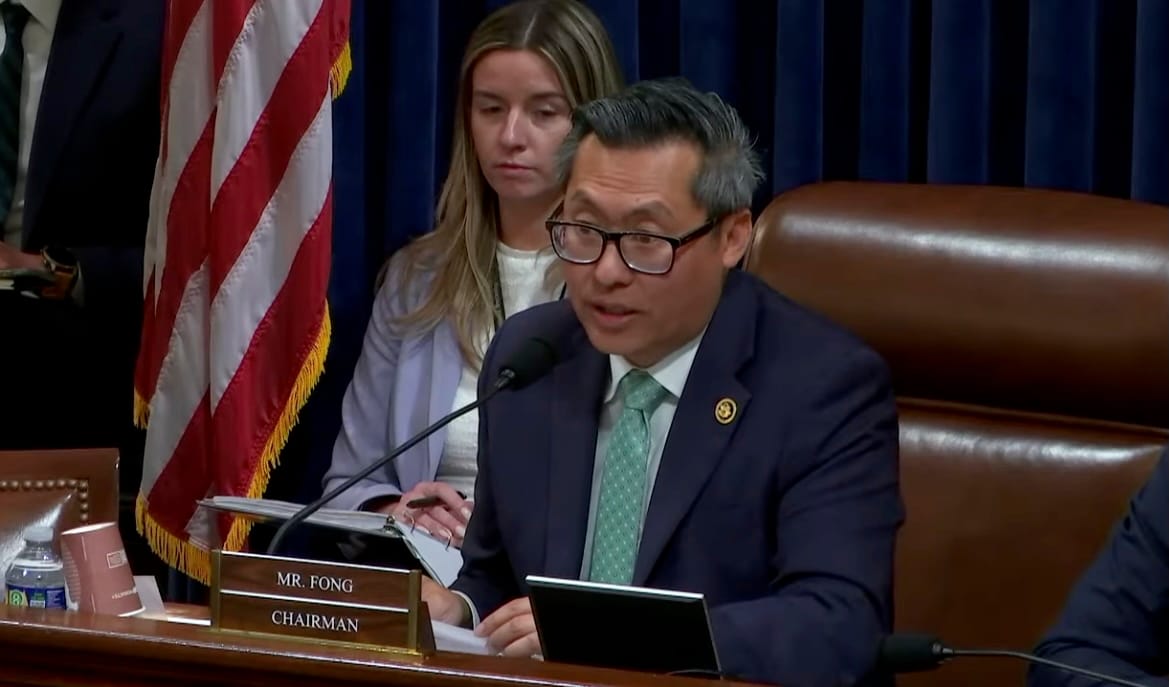
Chair Fong stated that the hearing examined national and economic security risks posed by artificial intelligence, robotics, and autonomous technologies linked to companies affiliated with the People’s Republic of China. He argued that China was aggressively pursuing dominance in emerging technologies through state support, data collection, and strategic market expansion, often replicating or acquiring U.S. innovation. He highlighted concerns about Chinese AI firm DeepSeek, alleging it used model distillation to improperly replicate U.S. systems and posed risks related to data storage and censorship aligned with Chinese government interests. He also warned that Chinese robotics companies had introduced vulnerable systems into U.S. environments, including law enforcement and government settings, with potential for surveillance and cyber exploitation. He emphasized that these developments created both competitive and security threats, particularly through data access and infrastructure exposure. He concluded that the United States should invest in domestic alternatives, strengthen cybersecurity practices, and prevent federal support for technologies that could advantage China.
Ranking Member Walkinshaw stated that rapid advancements in artificial intelligence and related technologies were reshaping both the economy and national security, requiring the United States to maintain leadership through innovation and risk mitigation. He emphasized that China’s state-driven industrial strategy and military-civil fusion posed a long-standing and serious threat, which Congress had historically addressed through bipartisan supply chain and export control measures. He argued that recent administration policies had weakened U.S. competitiveness by reducing the federal workforce in key agencies such as CISA, NSF, and NIST, thereby undermining cybersecurity and scientific leadership. He criticized trade and export decisions, including allowing advanced semiconductor exports to China, as counterproductive to maintaining a technological edge. He also stressed the importance of immigration in sustaining U.S. innovation, noting that restricting global talent would harm competitiveness against adversaries. He concluded that U.S. strength depended on both robust domestic investment and openness to talent, rather than policies that weaken institutional capacity.
SUMMARY OF WITNESS STATEMENTS
Mr. Max Fenkell stated that the United States remained ahead in AI models and chips but was falling behind China in data and real-world implementation, particularly in robotics. He explained that robotics systems required extensive physical-world training data, which China was producing at scale through state-supported infrastructure, giving it a significant cost and volume advantage. He warned that China’s dominance in robotics data created national security risks because the data shaped how future systems would behave and where vulnerabilities might emerge. He argued that this dependency could affect systems deployed in sensitive U.S. environments, including infrastructure and defense. He recommended treating AI data as a national asset, establishing a unified federal regulatory framework, mandating broader government adoption of AI, and expanding exports of U.S. AI technology to allies. He concluded that the United States had the resources to compete but needed urgency and coordinated government action.
Mr. Matthew Malchano stated that robotics was a critical extension of artificial intelligence and essential to economic and national security. He explained that robots were increasingly used across manufacturing, public safety, and defense, and that leadership in robotics would determine industrial competitiveness and resilience. He emphasized that advanced robots introduced new cybersecurity risks due to their integration of hardware, sensors, and mobility, which could enable physical disruption if compromised. He noted that robotics technologies were dual use and increasingly relevant for military applications, with China actively prioritizing the sector through national planning and investment. He highlighted that China had significantly outpaced the United States in robot deployment and was expanding its presence in U.S. markets through subsidized companies. He recommended developing a national robotics strategy and directing federal agencies to assess the security risks of foreign-built robotic systems.
Mr. Michael Robbins stated that the convergence of AI and robotics created both major economic opportunities and significant national security risks when dominated by adversarial ecosystems. He argued that China was executing a state-backed strategy to undercut U.S. companies through subsidies, intellectual property practices, and market flooding, similar to its approach in the drone industry. He warned that this strategy risked hollowing out the U.S. robotics industrial base and increasing dependence on foreign technologies embedded in critical infrastructure. He emphasized that compromised robotic systems could enable surveillance, disruption, and mapping of sensitive environments, posing greater risks than traditional cyber intrusions. He also highlighted supply chain vulnerabilities, including dependence on rare earth materials and Chinese components. He recommended a combination of restrictions on Chinese technologies and incentives for domestic production to restore competitiveness and protect national security.
Dr. Rush Doshi stated that artificial intelligence and robotics were reshaping the global balance of power, with China advancing rapidly through sustained industrial policy and strategic focus. He explained that China aimed to surpass the United States by dominating key technologies associated with the current industrial revolution, particularly robotics and AI. He noted that China had already taken a lead in robotics through large-scale manufacturing, investment, and deployment, while remaining competitive but slightly behind in advanced AI due to limitations in computing power. He warned that falling behind would increase U.S. dependence on China, create espionage risks through data-collecting systems, and weaken military deterrence given the dual-use nature of these technologies. He recommended restricting Chinese systems in sensitive environments, strengthening export controls on advanced semiconductors, auditing deployments in critical infrastructure, and building stronger alliances to counter China’s scale. He concluded that the United States still held key advantages but needed to act quickly to maintain them.
SUMMARY OF KEY Q&A
Chair Fong asked whether Chinese AI firms were using low-cost models like DeepSeek to rapidly expand global adoption and capture market share before U.S. alternatives could compete. Mr. Fenkell said China was pursuing a full AI tech stack strategy to drive global diffusion and that the United States needed to actively export its own technology stack to remain competitive.
Chair Fong asked about the risks posed by AI systems that censor information and reflect Chinese government propaganda narratives. Mr. Fenkell said such systems were shaped by state-imposed requirements and underscored the importance of deploying models aligned with democratic values and conducting rigorous evaluations.
Chair Fong asked what physical and operational risks could arise if a malicious actor gained control of a robot in a sensitive environment. Mr. Malchano said a compromised robot could act like a hostile actor by disrupting operations, damaging equipment, or conducting surveillance within critical facilities.
Chair Fong asked what lessons policymakers should take from China’s dominance in the drone market when considering AI and robotics. Mr. Robbins said policymakers should act early with policy tools to level the playing field rather than waiting until U.S. companies are already at a disadvantage.
Chair Fong asked whether Congress should restrict procurement of certain Chinese technologies similar to past actions on Huawei and DJI. Mr. Robbins said yes, restrictions were necessary to protect national security and ensure fair competition. Mr. Malchano said yes, similar procurement restrictions were appropriate based on prior precedent.
Ranking Member Walkinshaw asked about the importance of international collaboration in addressing PRC supply chain risks. Dr. Doshi said the United States should integrate with allied manufacturing and regulatory systems to collectively outscale China and build resilient supply chains.
Ranking Member Walkinshaw invited additional thoughts on allied cooperation. Mr. Robbins said collaboration with democratic allies was essential to ensuring that Western values shaped the future of AI and robotics.
Ranking Member Walkinshaw asked about the distinction between training chips and inference chips in robotics. Mr. Malchano said inference chips were critical for operating AI within deployed robots and should be included in policy frameworks alongside training chips.
Ranking Member Walkinshaw invited additional input on chips and alliances. Mr. Fenkell said allied cooperation was also essential for setting global AI standards and ensuring the United States led in both technology diffusion and governance frameworks.
Chair Fong asked what supply chain choke points China could exploit in a geopolitical crisis. Mr. Fenkell said U.S. dependence on Chinese-produced robotics data, which accounted for a dominant share of the market, represented a major strategic vulnerability. Mr. Robbins said the United States faced critical dependencies such as rare earth materials and needed both restrictions and incentives to strengthen domestic manufacturing. Dr. Doshi said addressing China’s cost advantages would require a combination of industrial policy, market protections, and government support similar to China’s approach. Mr. Malchano said the complexity of robotics supply chains required a coordinated national strategy to connect industry and government efforts.
Chair Fong asked whether it was feasible to decouple or nearshore supply chains away from China. Mr. Robbins said decoupling was possible but would require time, sustained policy commitment, and a comprehensive national strategy. Dr. Doshi said the United States should leverage its own advantages, such as semiconductor leadership and allied inputs, while mitigating Chinese leverage points. Mr. Fenkell said policymakers should treat data as a critical and often overlooked component of the AI and robotics supply chain. Mr. Malchano said increasing domestic demand and adoption of robotics through federal incentives would help drive production and reinforce U.S.-based supply chains.
ADD TO THE NIMITZ NETWORK
Know someone else who would enjoy our updates? Feel free to forward them this email and have them subscribe here.
Update your email preferences or unsubscribe here © 2026 Nimitz Tech 415 New Jersey Ave SE, Unit 3 |