- Nimitz Tech
- Posts
- Nimitz Tech Hearing - 2-06-2026
Nimitz Tech Hearing - 2-06-2026
News Flash: Oversight of FERC: Advancing Affordable and Reliable Energy for All Americans
ICYMI…
“Oversight of FERC: Advancing Affordable and Reliable Energy for All Americans”
House Energy and Commerce
February 3, 2026 (recording linked here)
HEARING INFORMATION
Witnesses and Written Testimony (Linked):
The Honorable Judy Chang, Commissioner, Federal Energy Regulatory Commission
The Honorable Lindsay See, Commissioner, Federal Energy Regulatory Commission
The Honorable David Rosner, Commissioner, Federal Energy Regulatory Commission
The Honorable David LaCerte, Commissioner, Federal Energy Regulatory Commission
The Honorable Laura Swett, Chairman, Federal Energy Regulatory Commission
HEARING HIGHLIGHTS
QUICK SUMMARY
State permitting and federalism dominated the pipeline discussion. Members from energy-producing states argued that state actions—particularly under the Clean Water Act—were effectively blocking federally approved natural gas pipelines, raising costs and reliability risks. FERC leadership said current law allowed states to functionally veto projects and suggested Congress could clarify or limit that authority if it wanted faster infrastructure buildout.
Reliability concerns sharpened after Winter Storm Fern. Members repeatedly pointed to storm pricing and fuel shortages to argue that dispatchable generation, especially natural gas, remained essential. Commissioners emphasized that regions lacking pipeline capacity paid dramatically higher prices and relied on less efficient fuels, reinforcing concerns about grid resilience during extreme weather.
Data centers and large loads were framed as both opportunity and risk. Lawmakers across parties stressed that AI and data centers could modernize the grid but warned that costs must not be shifted to captive ratepayers. FERC leaders said recent approvals required large loads to pay for needed upgrades and highlighted ongoing rulemakings to create durable, fair interconnection and cost-allocation frameworks.
Long-term planning and load forecasting were central themes. Members and commissioners agreed that traditional forecasting methods were no longer sufficient given the scale and uncertainty of new demand. FERC emphasized Order 1920’s role in bringing states into long-range transmission planning and said better data and objective criteria were essential to avoid overbuilding that would raise consumer costs.
Congressional action was repeatedly invited. Commissioners said clearer statutory direction—on permitting timelines, litigation limits, jurisdictional gray areas, and interregional planning—would improve certainty and reduce delays. Several members signaled bipartisan interest in targeted reforms to lower energy costs while preserving reliability and consumer protections.
IN THEIR WORDS
“Every agreement that we’ve approved at FERC since my tenure has provided for the data center to cover the full cost of the upgrades that are necessary for them.”
“We have more parts of the country at high risk and elevated risk of not having enough power to meet demand.”
“It has become clear to me why the head of NERC has labeled the current reliability crisis as a five alarm fire.”
SUMMARY OF OPENING STATEMENTS
Subcommittee Chair Latta stated that FERC’s core mission was to ensure electricity, natural gas, and oil were delivered safely, securely, and at reasonable prices. He said the electric grid was under extreme stress and cited warnings that reliability risks were reaching crisis levels. He argued that utility bills had risen significantly in recent years and that growing demand combined with baseload retirements had sharply increased blackout risks. He attributed these challenges to federal and state policies that prioritized renewable deployment over reliability-focused investments and to permitting delays and litigation that slowed infrastructure development. He said market signals had failed to attract new supply because pipeline construction and other projects were being blocked. He concluded that reliable and affordable energy was essential to economic competitiveness and the AI race and said FERC had begun refocusing on permitting reform, hydropower licensing, and clearer jurisdictional boundaries.
Subcommittee Ranking Member Castor said the hearing occurred during a period of rising energy costs and growing reliability challenges driven by data center load growth, extreme weather, and aging infrastructure. She described widespread outages during a recent winter storm and said damage to transmission and distribution systems highlighted vulnerabilities across the Southeast. She cited reliability assessments projecting significant growth in peak demand and identified load flexibility, streamlined permitting, and modernized grid planning as key solutions. She said renewable resources, storage, and batteries had helped offset generation outages during peak demand periods. She criticized recent administration actions that slowed renewable development and canceled energy funding, arguing they undermined grid reliability. She said FERC’s bipartisan actions on co-location and interconnection reform showed progress but stressed the need for transmission upgrades and permitting certainty across all resource types.
Full Committee Chair Guthrie said recent nationwide storms had underscored the importance of reliable and affordable power for American households and businesses. He stated that affordability and reliability challenges had intensified since the committee last heard from FERC and that preserving and expanding generation and infrastructure remained urgent. He said unprecedented demand growth tied to AI and economic expansion posed both national security and consumer cost challenges. He argued that responsibly connected data centers could help stabilize or reduce consumer bills. He emphasized that states played a central role in siting and permitting new generation, transmission, and large loads. He said he wanted to understand how FERC balanced affordability with the need to meet rapidly growing demand.
Full Committee Ranking Member Pallone said the nation was facing a serious affordability and reliability crisis and argued that electricity and natural gas prices had risen sharply across the country. He said FERC’s obligation to ensure just and reasonable rates was not being met and criticized grid operators for failing to connect new resources quickly enough. He argued that the administration’s opposition to clean energy had worsened price pressures and grid constraints. He said data centers should be connected to the grid only if they paid their fair share and did not shift costs onto families or threaten reliability. He called on FERC to act independently and ensure large technology companies were not benefiting at the expense of consumers. He warned that without major grid expansion, future extreme weather events could lead to more severe outages and higher prices.
SUMMARY OF WITNESS STATEMENTS
Chair Swett said the commission had been unified across party lines in carrying out Congress’s mandate to ensure reliable and affordable energy. She stated that legal durability and regulatory certainty were central to her leadership approach in order to reduce prolonged litigation and investment uncertainty. She said energy was foundational to national security and economic prosperity, particularly amid rapid load growth from technology and manufacturing. She described ongoing efforts to streamline FERC processes, shorten interconnection timelines, and advance infrastructure development. She said the commission had taken action to establish rules for large loads co-located with generation to protect consumers and grid reliability. She emphasized that affordability remained a core priority and that progress should not come at the expense of ratepayers.
Commissioner Rosner said FERC’s role as a bipartisan, resource-neutral regulator had become more complex due to rapid demand growth and evolving energy technologies. He said modernizing energy infrastructure was necessary to ensure reliability, affordability, and national security while addressing high consumer costs. He stated that FERC had accelerated new generation through interconnection reforms and had encouraged the use of automation and artificial intelligence to shorten study timelines. He said the commission had advanced long-term transmission planning reforms with greater state involvement to support economic growth. He described actions taken to pair large new loads, including data centers, with new generation to limit cost shifts and protect reliability. He said bipartisan and unanimous decision-making had strengthened regulatory predictability and legal durability.
Commissioner See highlighted the role of FERC staff in advancing energy resilience and described personal experience with storm-related outages to underscore the real-world stakes of reliability. She said reliable and affordable energy was essential for safety, medical care, economic growth, and national security. She characterized growing demand from AI and manufacturing as an opportunity that required innovation, legal rigor, and respect for regional differences. She said meeting future demand would require new generation, expanded pipelines, and additional transmission to deliver energy where it was needed. She emphasized the importance of grid-enhancing technologies and careful ratemaking to protect consumers from rising costs. She said legally durable decisions were necessary to send strong investment signals and ensure infrastructure was built quickly and sustainably.
Commissioner Chang said the energy sector had been undergoing a dramatic shift as demand growth—driven largely by data centers—had increased the need for major transmission and generation investments. She said serving large loads had created new challenges and exacerbated existing grid problems, while also offering a chance to modernize the system to improve reliability and efficiency. She stated that the buildout had contributed to high customer prices and said the commission had a responsibility to steer the industry toward cost-effective, durable solutions that protected consumers. She said consumer protection had to remain central because traditional captive ratepayers often bore expansion costs, and she argued that large new loads should cover the incremental costs they triggered to prevent cost shifts. She said she had focused on reducing bottlenecks—especially interconnection uncertainty and limited transmission capability—that created cost uncertainty for generators and perpetuated higher prices. She also warned against relying on temporary fixes and said FERC and regional entities needed durable reforms developed through robust stakeholder processes, including work on co-location rules and other long-term solutions.
Commissioner LaCerte said his approach at FERC was shaped by firsthand experience with the energy sector and public service. He stated that in his first months on the commission, FERC had approved a significant number of orders affecting markets, infrastructure permitting, and enforcement. He said those actions included approvals expanding natural gas transportation capacity to serve power generators, industrial users, and households. He identified his priorities as ensuring a reliable grid at affordable rates, positioning the United States to compete in the AI race, and accelerating permitting decisions. He emphasized the importance of completing reviews quickly while ensuring decisions were legally defensible. He said these priorities were central to meeting current energy reliability and affordability challenges.
SUMMARY OF KEY Q&A
Chair Latta asked whether the country needed more or less energy production. All Commissioners said the country needed more energy.
Chair Latta asked how FERC could achieve regulatory certainty so companies would invest in new energy infrastructure. Chair Swett said FERC was closing lingering dockets, reducing regulatory flip-flopping, and reviewing ways to expand blanket-style authorizations to provide clearer, more predictable rules and reduce litigation risk.
Chair Latta asked why FERC was suddenly able to move permits faster after years of delays. Commissioner Rosner said bipartisan, unanimous decisions improved predictability, reduced legal vulnerability, and allowed staff to proceed more efficiently by aligning NEPA reviews with statutory timelines and drafting orders in parallel.
Ranking Member Castor asked why FERC’s interconnection reforms under Order 2023 were important for affordability and reliability. Commissioner Chang said the reforms prioritized ready projects through cluster studies and higher financial commitments but warned that inadequate transmission capacity remained a major bottleneck.
Ranking Member Castor asked how automation and AI could accelerate interconnection studies and what Congress could do to help. Commissioner Rosner said automated power-flow tools had reduced study timelines from hundreds of days to under ten days while maintaining accuracy, and he said Congress could encourage adoption but grid operators could act immediately without new rulemakings.
Chair Guthrie asked whether FERC could deliver timely solutions to connect data centers seeking rapid grid access. Chair Swett said her top priority was establishing clear rules within FERC’s jurisdiction so large loads and associated generation could connect as quickly as possible.
Chair Guthrie asked how FERC could balance large-load interconnections with affordability. Commissioner LaCerte said FERC should give flexibility to states, RTOs, generators, and loads while using co-location with consumer safeguards and respecting regional differences. Commissioner Rosner said FERC focused on making multiple pathways legal, particularly pairing new generation with new loads to reduce infrastructure costs and limit impacts on residential customers.
Chair Guthrie asked about the role states played in meeting growing demand reliably and affordably. Commissioner See said states provided frontline expertise on resource adequacy and regional needs and that FERC needed to partner cooperatively with them. Commissioner Chang said states were already leading on affordability and large-load integration and that close coordination with state regulators was essential.
Ranking Member Pallone asked whether each commissioner would commit to prioritizing affordability in all decisions. All Commissioners said yes.
Ranking Member Pallone asked how FERC’s priorities would improve reliability and keep electricity affordable. Commissioner Rosner said high prices reflected supply scarcity and that faster interconnection, stronger transmission planning, and credible load forecasting would unlock investment while ensuring costs were allocated to the appropriate parties.
Ranking Member Pallone asked why long-term interconnection and transmission solutions were preferable to ad hoc fixes. Commissioner Chang said FERC’s reforms were grounded in non-discriminatory open-access principles and needed to work for all resources and customers rather than a narrow subset.
Rep. Weber asked when FERC expected to issue a proposed rule on blanket LNG authorizations and how it would help infrastructure deployment. Commissioner See said staff was reviewing public input and that she was focused on moving quickly while ensuring legal durability, emphasizing that infrastructure constraints—not gas supply—were the primary challenge.
Rep. Weber asked how FERC could reduce duplicative LNG safety oversight across federal agencies. Commissioner Rosner said PHMSA should lead on safety standards under statute and noted that lengthy delays often stemmed from non-FERC processes even when FERC met its own deadlines.
Rep. Peters asked how interregional transmission cost allocation could gain the same confidence as intraregional planning. Commissioner Rosner said giving state regulators a stronger role early in planning had improved consensus regionally and said a similar approach could work for interregional projects.
Rep. Peters asked whether Congress needed to provide direction on interregional transmission planning. Commissioner Rosner said FERC had focused more on regional planning than interregional and welcomed congressional guidance if interregional transmission was a priority.
Rep. Peters asked whether FERC should hold siting authority for national-interest transmission corridors instead of the Department of Energy. Commissioner Rosner said the current statutory process was too slow and said Congress could consider giving FERC additional tools while preserving state roles.
Rep. Peters asked whether interregional transmission could be market-driven rather than federally mandated. Commissioner See said cooperation among regions had proven effective during recent storms and emphasized collaboration over mandates.
Rep. Allen asked whether other regions could replicate Georgia’s success in connecting large loads while maintaining affordability. Commissioner LaCerte said Georgia’s public service commission provided a strong model and said other regions could learn from its approach to interconnection and planning.
Rep. Allen asked how electric transmission differed from natural gas pipelines in permitting and cost allocation. Chair Swett said the bulk electric system was far more complex, involved differing state resource preferences, and required cost-sharing across states with varying policy choices, unlike pipelines where shipper interests were aligned.
Rep. Allen asked for additional perspective on permitting parity between pipelines and transmission. Commissioner Rosner said the country needed both electrons and molecules and said Congress ultimately needed to determine how best to structure authority.
Rep. Menendez asked why FERC pursued a rulemaking on co-locating generation with large loads. Commissioner Rosner said the Commission wanted to make all options legally available, reduce infrastructure needs, and allow faster connections while maintaining reliability safeguards.
Rep. Menendez asked whether co-locating generation with data centers could lower costs for residential ratepayers. Chair Swett said affordability and just and reasonable rates guided the Commission’s approach and informed the unanimous direction given to PJM.
Rep. Menendez asked how FERC would ensure data centers paid the full cost of their demand. Chair Swett said data center developers had consistently agreed to cover connection costs and were often seeking to bring their own generation to reduce grid impacts.
Rep. Menendez asked whether FERC was committed to strict oversight of grid operators to protect residential consumers. Chair Swett said FERC regulated roughly one-third of consumer bills and was fully committed to consumer protection within its jurisdiction.
Rep. Palmer asked whether rising transmission costs driven by renewable mandates contributed to higher electricity prices. Commissioner LaCerte said new transmission was necessary but needed to be carefully planned and paired with expanded pipeline capacity to reduce overall costs.
Rep. Palmer asked how rising material costs affected electricity prices. Commissioner LaCerte said higher costs for materials and equipment increased infrastructure expenses and made careful planning and supply-chain resilience essential.
Rep. Palmer asked whether retired coal sites could be repurposed for advanced generation such as small modular reactors. Commissioner LaCerte said repowering existing sites with new technologies was a practical approach and said all options deserved consideration.
Rep. McClellan asked how FERC ensured disadvantaged communities and tribes could meaningfully participate in decision-making. Chair Swett said FERC was required to consider all comments, used pre-filing outreach, and relied on the Office of Public Participation to educate communities and facilitate engagement.
Rep. Balderson asked whether LNG exports acted as a balancing tool during peak domestic demand. Commissioner See said LNG exports provided flexibility, redirected supply during emergencies, and highlighted that infrastructure constraints—not supply—were the main challenge.
Rep. Balderson asked what additional steps FERC was taking to expedite pipeline construction. Chair Swett said FERC was streamlining NEPA reviews, reassessing requirements that exceeded statutory obligations, and focusing on its role as an economic rather than environmental regulator.
Rep. DeGette asked whether the commissioners supported an all-of-the-above energy strategy. All Commissioners said yes.
Rep. DeGette asked whether FERC and Congress should support building generation and transmission. Commissioner Chang, Commissioner See, and Commissioner LaCerte said yes, while Chair Swett emphasized state authority over generation decisions and said transmission was valuable when appropriately sited.
Rep. DeGette asked whether expedited interconnection programs alone could solve grid constraints. Commissioner Chang said faster studies were insufficient without expanding transmission capacity to handle new loads and generation.
Rep. Harshbarger asked how FERC evaluated rate increases for pipelines with captive customers. Commissioner See said FERC closely scrutinized records to ensure increases were justified, while Commissioner LaCerte said expanding pipeline capacity was essential to protecting consumers.
Rep. Harshbarger asked how FERC ensured pipeline rate cases were processed efficiently. Chair Swett said she was reviewing ways to reduce litigation burdens and improve efficiency and said Congress could help limit litigation exposure.
Rep. Harshbarger asked how rising load forecasts influenced FERC’s modernization of its blanket certificate program. Commissioner LaCerte said uncertainty in load forecasting complicated planning but said increased generation, transmission, and pipeline capacity were unavoidable.
Rep. Matsui asked how utilities recouped capital costs from customers. Commissioner Chang said investor-owned utilities made capital investments and passed the return on those investments directly to customers, while municipal and public power entities used different accounting, and she said the scale of investment ultimately flowed through to captive ratepayers.
Rep. Matsui said canceling federal grid-resiliency grants would shift capital costs onto ratepayers through higher bills and asked if that was correct. Commissioner Chang said capital had to come from somewhere and that unless projects were canceled, the costs generally went to ratepayers if other funding was not available.
Rep. Matsui asked what FERC and Congress could do to encourage advanced transmission technologies that could add capacity faster and at lower cost. Commissioner Chang said the U.S. should lead on transmission technology, said she did not want to prescribe specific technologies project-by-project, and said utilities should move from pilots to broad adoption to squeeze more capacity from existing and new systems and bring down consumer costs.
Rep. Matsui asked how FERC should approach interconnection for large loads. Chair Swett said FERC’s bulk-power jurisdiction covered large-load connections, said large loads had multiple options across state and federal jurisdiction, and said FERC would facilitate connections within its authority while ensuring consumers paid just and reasonable rates.
Rep. Matsui asked whether Commissioner Rosner shared that view. Commissioner Rosner said the Commission had jurisdiction over connecting large loads to the transmission system and said the Commission had been working to make that process more efficient.
Rep. Miller-Meeks asked whether recent fast-track activity and approvals were consistent with capacity additions from 2021–2024. Commissioner Rosner said he did not have the backward-looking number available but said the Commission had approved fast-track processes expected to connect about 50 gigawatts of new generation and said he would provide the historical figure for the record.
Rep. Miller-Meeks asked whether adding that capacity would help keep prices affordable. Commissioner Rosner said it would support affordability and reliability.
Rep. Miller-Meeks asked who bore the risk when load forecasts swung and infrastructure was procured or built on projections that later proved too high. Commissioner See said overbuilding and underbuilding both harmed consumers, said forecasting was harder because large loads like data centers created new uncertainty, and said FERC was working toward better consensus and best practices to improve confidence even if forecasts could not be perfect.
Rep. Miller-Meeks asked whether any mechanism existed to true up costs when forecasts proved too high. Commissioner Rosner said markets often used adjustment auctions to recalibrate commitments as information improved and said better forecasting helped drive agreement on what to build.
Rep. Veasey asked whether connecting lower-cost generation sooner through a “connect and manage” approach—even with some curtailment risk—was better for consumers than waiting years for full deliverability. Commissioner Rosner said Texas demonstrated the value of faster interconnection, said more options were needed to shorten timelines nationwide, and said connect-and-manage-type approaches could help if responsibly structured.
Rep. Veasey asked what FERC could do to ensure Order 2023 actually reduced delays. Commissioner Rosner said completing nationwide compliance mattered and said industry-led consensus filings and automation could accelerate progress faster than additional regulation.
Rep. Veasey asked whether faster interconnection with developers bearing risk was preferable to prolonged delays that kept prices high. Commissioner Chang said transmission constraints remained the core bottleneck, said connect-and-manage could work if paired with a clear and financed transmission upgrade plan, and noted that FERC-jurisdictional markets required generators to pay upgrade costs they triggered.
Rep. Bentz asked whether national security risks from Chinese-manufactured transformers had been resolved. Chair Swett said the risk remained present.
Rep. Bentz asked how hydropower relicensing timelines could be shortened. Commissioner LaCerte said NEPA reviews needed to focus on statutorily required analysis and said permitting delays reflected both federal and state processes.
Rep. Bentz asked whether affordability had to be traded off against competing in the AI race. Commissioner LaCerte said the country needed a balanced approach and had to achieve both.
Rep. Ocasio-Cortez asked whether FERC’s mission included helping consumers obtain efficient energy at reasonable cost. Chair Swett said yes.
Rep. Ocasio-Cortez asked whether a fixed return-on-equity model was the most economically efficient approach for consumers. Chair Swett said the Commission scrutinized cost drivers closely, debated aggressively to lower bills, and was open to working with Congress on improvements.
Chair Guthrie asked how FERC approached permitting interstate gas pipelines needed to lower costs. Chair Swett said FERC evaluated whether projects met the public convenience and necessity standard and said economic benefits to consumers were central to that analysis.
Chair Guthrie asked whether pipeline capacity reduced prices. Chair Swett said recent winter storm pricing showed regions without adequate gas infrastructure paid dramatically more, which she said was unacceptable.
Rep. Fry asked how FERC changed NEPA practices after the Seven County decision. Chair Swett said FERC stopped analyzing upstream and downstream emissions, stopped using GHG emissions to trigger more burdensome reviews, and stopped relying on the social cost of carbon.
Rep. Schrier asked how FERC would address market seams as Western utilities joined different day-ahead markets. Chair Swett said FERC stood ready to evaluate proposals and ensure outcomes resulted in just and reasonable rates.
Rep. Lee asked about the role of FERC’s Office of Energy Infrastructure Security. Chair Swett said the office coordinated with intelligence and federal partners, worked directly with utilities to identify vulnerabilities, and supported both best practices and cybersecurity standards.
Rep. Tonko asked why improved long-term planning and load forecasting mattered as demand rose. Commissioner Rosner said better data enabled better decisions and said objective criteria and coordination among grid operators reduced uncertainty and overbuilding.
Rep. Langworthy asked how pipeline bottlenecks in the Northeast affected reliability and affordability. Commissioner See said gas and electric systems were increasingly interdependent, said constrained pipeline capacity limited delivery of needed fuel, and said she would closely scrutinize records to advance infrastructure within FERC’s statutory authority.
Rep. Rulli said states had blocked critical natural gas projects and asked how state actions had affected natural gas development and reliability, citing Ohio’s shale resources and pipeline constraints affecting industrial projects. Chair Swett said the federalist permitting structure allowed states to effectively veto projects and said FERC could not override those state decisions.
Rep. Rulli asked what Congress could do to win bipartisan support for expanding pipelines and asked whether Clean Water Act reform could help. Chair Swett said FERC staff could provide technical support and said the Clean Water Act likely needed revision to limit states’ ability to effectively veto federally approved projects.
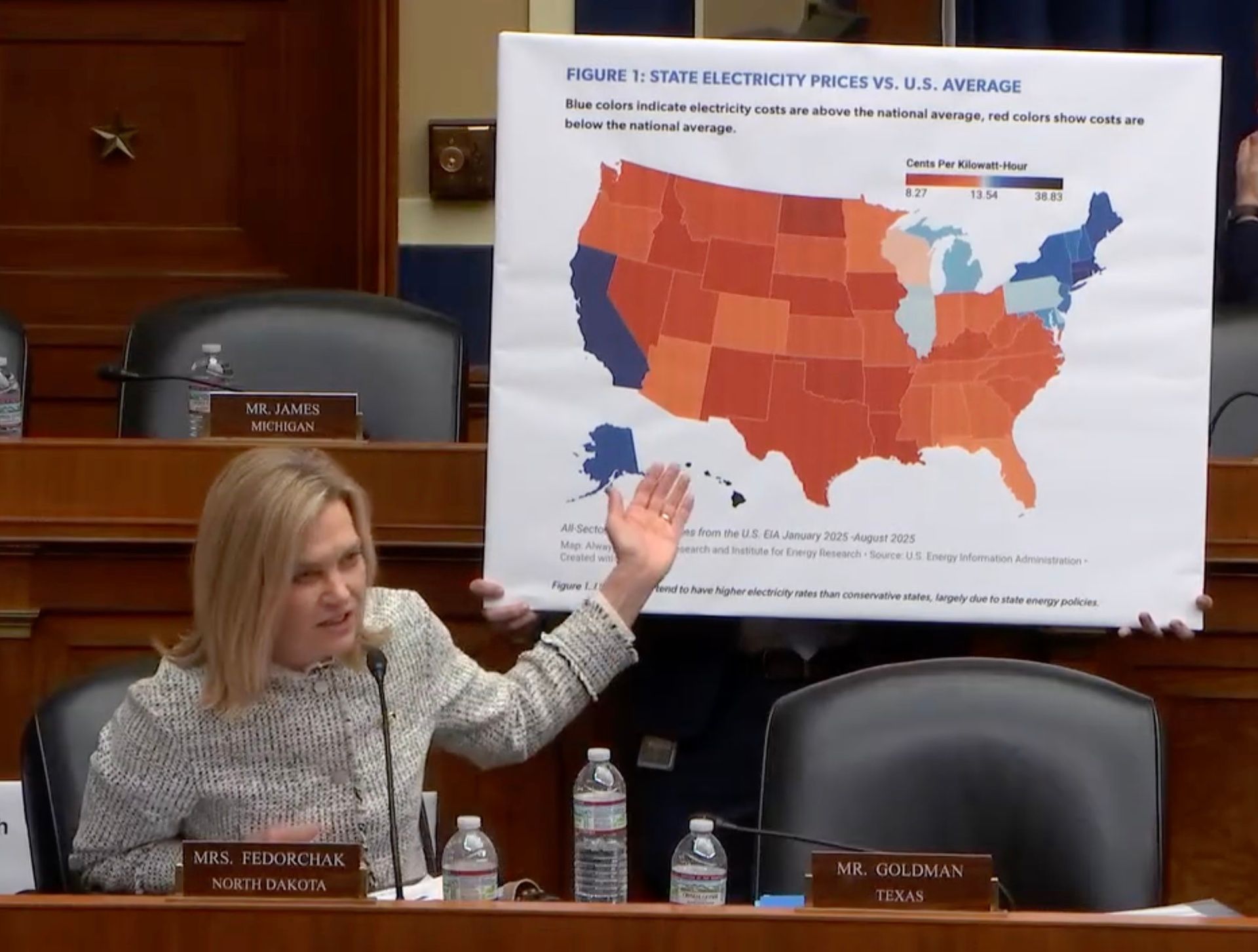
Rep. Fedorchak said states with low-cost, reliable energy benefited from fundamentals while high-cost states faced reliability risks, and she asked what Congress could do to help FERC move faster. Chair Swett said Congress could help by setting timelines or limits around state permitting decisions, tightening appeal windows to reduce years of litigation, and clarifying jurisdictional “gray areas” that created uncertainty.
Rep. Fedorchak asked about Chair Swett’s review of FERC rules and the timeline for clearing backlogs. Chair Swett said she was addressing a large backlog caused by lack of quorum and hard-to-resolve items and said she intended to keep scrutinizing and clearing that backlog throughout her tenure.
Rep. Landsman pressed how quickly FERC could reduce utility bills by lowering allowed returns and profits, and he urged faster relief for ratepayers. Chair Swett said commissioners repeatedly pushed to reduce charges in rate dockets by scrutinizing returns and pass-through impacts, but she noted FERC-controlled costs generally represented about one-third of a typical bill.
Rep. Landsman asked how FERC ensured data centers paid the full costs of grid upgrades. Chair Swett said agreements approved during her tenure required data centers to cover the full cost of necessary upgrades and said many data center developers also indicated willingness to contribute more broadly to support local systems.
Rep. Goldman asked what the biggest opportunities were to improve FERC and what Congress could do to help. Chair Swett said clearer congressional direction on jurisdictional gray areas—especially permitting—would help FERC execute its mission more efficiently, and she emphasized improving morale and responsiveness inside the agency.
Rep. Goldman asked whether FERC could meet the April 30, 2026 deadline requested by Secretary Wright for data-center-related rulemaking and fast-track work. Chair Swett said FERC was moving as efficiently as possible but had to comply with the Administrative Procedure Act and work through extensive, substantive comments to produce a legally durable outcome.
Rep. Goldman asked how Congress could make faster, higher-volume approvals of natural gas projects more permanent. Commissioner Rosner said bipartisan consensus at the Commission improved speed and legal durability and said broad all-of-the-above permitting reform or clearer statutory direction would help, while FERC would still pursue internal efficiencies within existing authorities.
Rep. Mullin asked what cost-allocation approaches best protected consumers from large-load costs like data centers. Commissioner Chang said upgrades should be treated as an opportunity to improve the system for everyone, but she warned that if upgrades primarily benefited large customers without systemwide benefits, costs should not be shifted to existing captive ratepayers.
Rep. Mullin asked why strict compliance with Order 1920 mattered for reliability and affordability. Commissioner Rosner said Order 1920 brought states in early for long-term planning, scenario development, and regional cost-sharing, and he said better transmission planning would reduce expensive upgrade costs that were blocking new generation and raising costs.
Rep. Mullin asked how real-time data access affected demand response and consumer costs. Commissioner Rosner said real-time data was critical because demand response let consumers and businesses voluntarily reduce usage when prices spiked, which could lower overall costs and improve system flexibility.
Rep. Joyce asked how FERC could guide when proposed large-load demand should count in load forecasts and what risks came from inaccurate forecasts. Commissioner LaCerte said inaccurate forecasts either left consumers paying for unnecessary buildout if demand was overstated or risked reliability if demand was understated, and he said better data and stronger consensus forecasting were needed.
Rep. Joyce asked how FERC could ensure existing generators were not disadvantaged in long-term deals with large loads compared to new generation. Chair Swett said FERC had to act in a non-discriminatory manner and would evaluate agreements on their merits to ensure just and reasonable outcomes.
ADD TO THE NIMITZ NETWORK
Know someone else who would enjoy our updates? Feel free to forward them this email and have them subscribe here.
Update your email preferences or unsubscribe here © 2026 Nimitz Tech 415 New Jersey Ave SE, Unit 3 |